

Part S of the Building Regulations sets out what new and renovated buildings in England must do to support electric vehicle charging. It has applied since 15 June 2022, and for housebuilders it is now a standard part of getting a new home signed off. This guide covers what the rules require, when they apply, and where the practical flexibility sits. It reflects the requirements in force as of 2026.
What Part S is, and when it applies
Part S was introduced by the Building Regulations etc. (Amendment) (England) Regulations 2021 and came into force on 15 June 2022. It requires EV charging infrastructure in new buildings, and in some renovated ones. The technical detail sits in Approved Document S.
It applies to new residential buildings, dwellings created through a material change of use, residential buildings undergoing major renovation, new non-residential buildings, non-residential buildings undergoing major renovation, and mixed-use buildings that are new or being renovated. It applies in England only. Scotland, Wales and Northern Ireland have their own building standards with similar but not identical rules, so check the right regime for the location of your development.
New-build homes: the core requirement
For a new home with an associated parking space, the rule is straightforward. Each dwelling with its own parking space must have an EV charge point of at least 7kW. Where the electrical supply cannot support a charge point, you must instead install a cable route, the ducting that allows a charger to be fitted later without major works.
The 7kW minimum matters because it is the point at which a home charger delivers a useful overnight charge, roughly 30 miles of range per hour. Anything less would not meet the standard.
Renovations and non-residential buildings
The rules widen out beyond new homes:
Residential buildings undergoing major renovation that will have more than 10 parking spaces must install charge points for the dwellings, with cable routes provided for the remaining spaces.
New and renovated non-residential buildings with more than 10 parking spaces must have at least one charge point, plus cable routes for at least one in five of the remaining spaces.
Mixed-use buildings are treated by use. The residential part follows the dwelling rules, and the commercial part follows the non-residential rules, applied to each set of associated parking spaces.
The £3,600 cost cap
Part S includes a cap to stop compliance becoming prohibitively expensive. Where the average connection cost per charge point would exceed £3,600, you are required to install the maximum number of charge points that is possible within that cap, rather than every space. The rest can be served by cable routes. If you rely on this, the evidence needs to be available for building control.
When charge points are not required
There are defined situations where a charge point does not have to be installed:
- Insufficient electrical supply. Where the supply to the building or car park cannot support charge points for all associated spaces, a cable route can be provided instead. You need to give evidence of this to the building control body.
- The £3,600 cap applies as above.
- Covered car parks and certain historic or traditional buildings, where a charge point would unacceptably alter the character or appearance of the building, may fall outside the requirement.
These are not loopholes to lean on. They are specific, evidenced exceptions, and building control will expect to see the justification.
Getting sign-off
Installing an EV charge point is notifiable work, because it involves a new circuit. It must be signed off by building control, or carried out by an installer on a competent person scheme who can issue a compliance certificate. Installations above 3.68kW also require notification to the local Distribution Network Operator under the wiring regulations, so the network can check the supply can take the load. Building the evidence trail as you go is far easier than assembling it at inspection.
What this means for your developments
For most new-home developers, Part S is now business as usual: a 7kW charger, or a cable route where the supply will not stretch, on every plot with parking. The work is less about the regulation itself and more about keeping clean, plot-level evidence that each home meets it, ready for building control sign-off and for the buyer’s records after handover.
That is also where it pays off commercially. A home that arrives ready to charge is an easier sell to a buyer who already owns an EV or is planning to, and it removes a retrofit cost and a conversation later down the line.
Keeping your compliance evidence in order
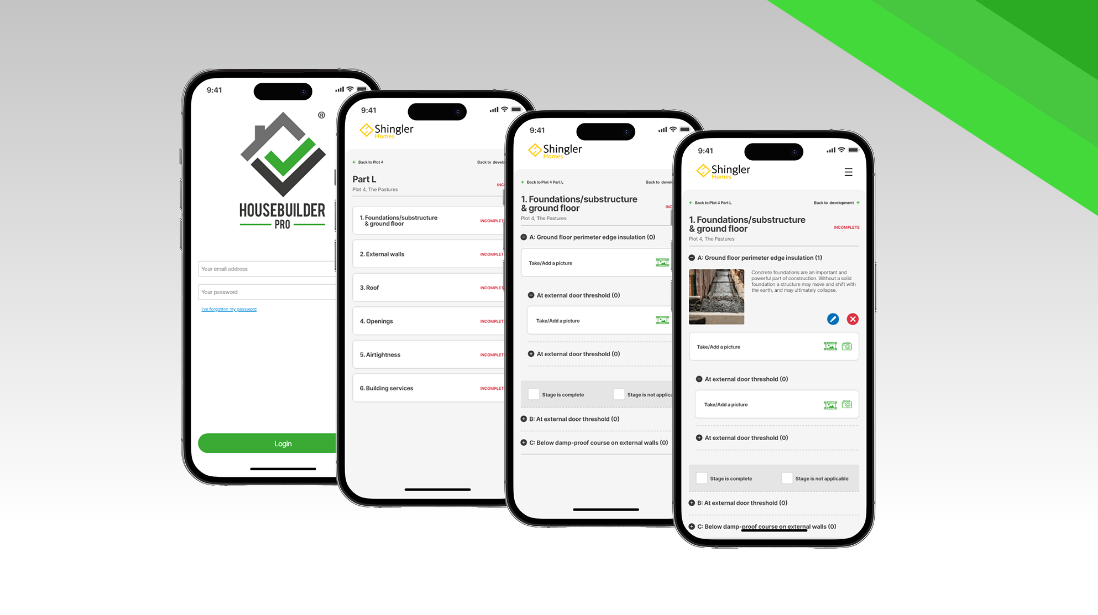
Part S sits alongside Part L, Part B and your NHBC obligations, and all of them need the same thing: accurate records, captured on site, held against the right plot, and easy to produce when building control asks. Housebuilder Pro gives site teams a mobile-first way to capture and store that evidence per plot and generate clean reports for sign-off, so nothing goes missing between the site and the office.
Frequently asked questions
Do all new homes need an EV charger under Part S? Every new home with an associated parking space needs an EV charge point of at least 7kW. Where the electrical supply cannot support one, a cable route must be installed instead so a charger can be added later.
What is the minimum charge point specification? At least 7kW. This delivers a useful overnight charge, around 30 miles of range per hour.
When did Part S come into force? 15 June 2022, for building work in England submitted or started from that date.
Does Part S apply in Scotland, Wales and Northern Ireland? No. Part S applies in England. The other UK nations have their own building standards with comparable but different requirements, so check the rules for your development’s location.
What happens if the electrical supply cannot support a charger? You can install a cable route instead of a live charge point, but you must give building control evidence that the supply is insufficient.
Request a demo
Find out more about Housebuilder Pro, the only complete new homes management system designed and developed to accelerate your business.
Book via